MIDDLETOWN, Iowa — The U.S. Army intentionally blew up the nation’s entire stockpile of lead azide, a chemical used to make explosives, saying early signs Wednesday indicated the controlled detonation in Iowa did not allow any toxic dust to spread to nearby homes and farms.
Those in charge called it a success. All 5 tons of lead azide were successfully destroyed at the Iowa Army Ammunition Plant in Middletown, Maj. Gen. Eric Shirley, who led the Army operation, said at a news conference.
U.S. Environmental Protection Agency air monitors were reporting no lead in the air around the plant.
The risk to the surrounding communities was “reduced as close to zero as it’s absolutely humanly possible,” Shirley said.
Still, government agencies plan to do more testing in the days and weeks ahead. Independent researchers also intend to do extensive environmental testing on water sources, farms, homes and playgrounds. Lead is a heavy metal that’s unsafe at any level, and is especially dangerous to children and pregnant women.
Video footage from several miles away showed two white plumes rolling over the detonation site before the clouds quickly dissipated. Journalists reported hearing a loud boom at the same time. Despite warnings to stay inside, some residents pulled to the side of a road to watch the blast upwind from the ammunition plant.
Environmentalists voiced concerns about possible health and environmental effects from the controlled detonation of the bomb-making chemicals at the Iowa Army Ammunition Plant in Middletown. But officials said the degraded materials were at risk of exploding uncontrollably as temperatures cooled. They warned about the dangers of waiting too long, and a court ultimately cleared the way for the military to carry out the blast.
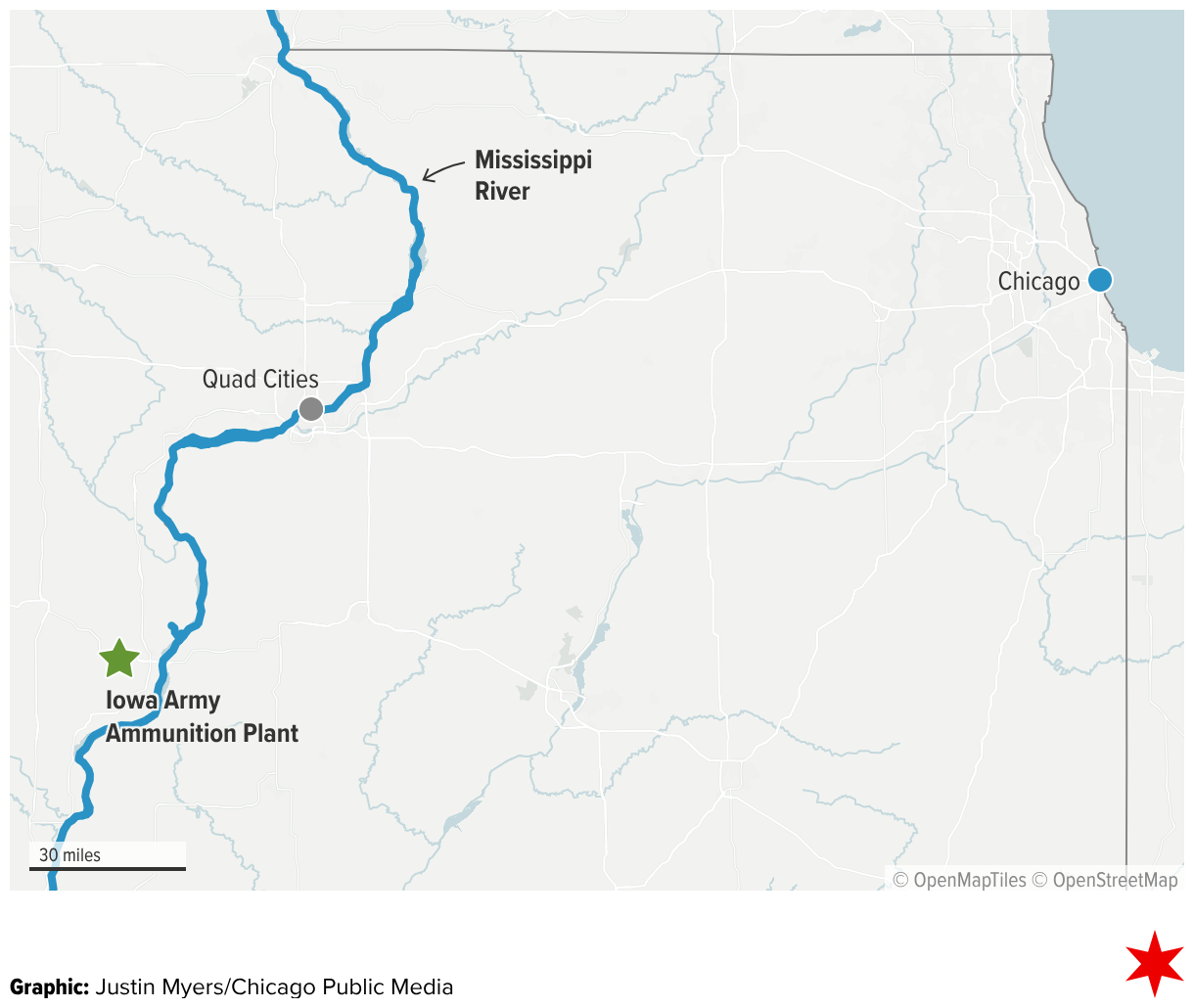
The demolition occurred at an Army Ammunition Plant in Middletown, Iowa, near the Illinois border and about 80 miles southwest of the Quad Cities.
The explosion was expected to create a dust plume containing lead. Lead is toxic to humans and animals. Before the detonation, the Army projected that the plume would head southwest, and not into Illinois. The Army released maps Tuesday showing the projected path of the plume.
Melinda Beerends, a meteorologist with the National Weather Service Quad Cities forecast office, confirmed that assessment Wednesday morning, saying the winds were from the northeast, blowing southwest at about 10 mph. She added, though, that she could not determine how far the winds would carry the plume.
On Monday afternoon, a federal appeals court cleared the way for the detonation. The order by the 8th Circuit U.S. Court of Appeals was one of two decisions President Donald Trump said he was awaiting after he ordered the Army earlier in the day not to detonate the chemicals without court approval, according to the Associated Press.
Trump had weighed in on social media, saying he would defer to the courts on whether the administration should move ahead. He also said in a statement that his decision was subject to agreement by Iowa Gov.-elect Rob Sand. Though if Sand and the court don't agree, Trump said, the administration would not proceed with the detonation. He said he would hold Sand responsible.
“We think there has been significant negligence that has come to light, and it is very frustrating,” said Michael Schmidt, general counsel for the Iowa Environmental Council, one of the groups that filed a lawsuit to stop the detonation.
“But at this point, there are many more resources for people who are concerned and … I think people are in a much better place to be able to get help when they need it and have a better understanding of who needs help than we did before we filed the lawsuit,” he said.
The Army moved the planned explosion from Friday to Monday before pushing it to Wednesday after politicians from Iowa and Illinois asked for a delay and environmental groups filed a lawsuit to pause the detonation. Wednesday was chosen for optimal weather conditions, the Army said.
Here are those Army maps showing how the lead plume would travel.
The air dispersion map:
And here's the map showing surface dispersion:
Here’s what else you need to know.
There was a risk that these stored materials would have detonated on their own, and moving them also could have triggered an explosion, according to the Defense Department. The issue was discovered earlier this year and plans to blow them up have been going on for months.
While the Army has destroyed weapons and materials in the past, it has never blown up such a large amount of this particular chemical, according to a spokesperson.
“We detonate all the time, but we have not detonated lead azide at this quantity,” said Lori McFate, public affairs specialist with the Army Sustainment Command in Bettendorf, Iowa.
McFate said the explosion took place after months of planning. The procedure received a green light from the U.S. Environmental Protection Agency regional office in Kansas City. That’s a different jurisdiction than the regional EPA office in Chicago, which oversees environmental protection in Illinois.
Lead azide is a compound of lead and nitrogen, used to make bombs. About 5 tons of it was blown up.
“The lead azide has aged. It's become unstable to the point where moving it or even allowing it to sit on the odd chance that it receives some sort of shock or friction could lead to a spontaneous explosion,” said Greg Domski, associate provost and professor of chemistry and biochemistry at Augustana College in Rock Island.
The lead dust is not expected to blow toward Chicago. Winds at the time of the detonation were blowing in the opposite direction, to the southwest.
Mayor Brandon Johnson told WBEZ Wednesday that city officials were "monitoring" the aftermath of the detonation, but there was "no indication" that it would have an impact on Chicago.
Gov. JB Pritzker directed state agencies to "remain on standby" for any unanticipated impact to Illinois until the detonation is deemed complete and final data is released from the federal government, the Illinois Department of Public Health said in a statement.
Illinois has created a webpage where residents can find the latest information on the situation. The Illinois EPA and the Illinois Emergency Management Agency and Office of Homeland Security will continue monitoring conditions.
Prior to the detonation, Brian Pierce, a meteorologist with the National Weather Service Quad Cities forecast office said winds would blow the smoke into Iowa and potentially northeast Missouri.
“It would be blowing it to the southwest across the far southeast parts of Iowa,” Pierce said. “There’s a question of how high the plume would get, which we won’t know until it actually happens.”
The EPA says there is no safe level of lead exposure. It is a neurotoxin that damages the central nervous system. It’s particularly harmful to children, as their brains and nervous systems aren’t fully developed. Exposure to lead is associated with cognitive delays, heart problems and reproductive issues.
“Lead is an element, and doesn't break down,” said Robert Hirschfeld, director of water policy at the Prairie River Network, a Champaign-based environmental advocacy group. “Those health risks persist as long as the lead does.”
U.S. Sen Dick Durbin wants the Trump administration to send a public health emergency team to assess the risk and damage from the explosion.
As part of the controlled detonation, federal officials installed air monitors and will continue to conduct environmental sampling of the blast area.
Environmentalists who sued last week to stop the detonation said in court filings that there is no safe exposure level for lead, which is especially harmful to children. Lead has been shown to permanently damage children’s brains and development.
They said lead also is harmful to adults and has been linked to heart, kidney and liver disease as well as reproductive harm, cognitive decline and cancer.
Researchers from the University of Illinois Urbana-Champaign are on the ground in Iowa to assist with soil sampling after the detonation.
Federal officials say the detonation could impact 350 farms in Iowa and Missouri. The U-S Department of agriculture says staff will be available to support farmers and ensure the food supply chain is safe.
For locations likely to be affected, the agricultural impacts of the lead dust are still unknown, Hirschfeld said.
“We’re past harvest now, and so all of that lead is going to land on bare soil and that lead will stay there and contaminate that soil,” he said.
He said lead contamination could go beyond the potentially impacted farmland and crops, and trickle down to animals, whether livestock or wildlife, that graze on the land.
The environmentalists who sued said the Army’s own modeling showed that a large amount of farmland in the area as well as waterways could be contaminated with lead dust from the detonation.
“Once lead dust is dispersed, there is no undoing the harm,” one filing stated. “Lead persists in the environment and spreads easily between media. Lead dust in the air will not just disappear once it settles to the ground—people, cattle, chickens and wildlife will continue to face exposures to lead from soil, water runoff, and deposition into waterbodies.”
The Illinois Department of Public Health recommends the following safety tips:
Contributing: Isabela Nieto, Misha Manjuran Oberoi